Table of Contents
Advertisement
Choose the enclosure that suits your English home
A screen enclosure is not automatically the best choice. Mesh works well for airflow. However, many homes in England fall below 18°C in winter. An all-mesh enclosure can lose heat and dry out too quickly unless the room itself is suitable.
Is mesh, glass or PVC best?
| Type | Best room conditions | Heat retention | Drainage requirement |
|---|---|---|---|
| Screen vivarium | Warm room, roughly 20-24°C by day | Low | External tray or drain beneath |
| Glass terrarium | Stable room, with generous opposing vents | Medium | False floor or drilled drainage route |
| PVC enclosure | Cooler rooms, with designed vents | High | Drain tray or plumbed outlet |
| Paludarium | Usually unsuitable for common pet species | Variable | Built-in water management |
Does your room need extra heat planning?
A temperature gradient gives the chameleon a warmer basking area. It also provides cooler places where it can move away from the heat. It is like choosing between a sunny seat and shade in a garden. A halogen basking lamp normally provides daytime heat. A thermostat limits the heat source, preventing the temperature from climbing too far.
Heat and airflow must work together.
Buy usable climbing height, not a “complete” kit
An adult veiled or panther chameleon needs at least 90 cm of clear, usable internal climbing height. For most adult males, 120 cm is preferable. The number printed on a box may include a drainage base. It may also include lamp fittings or a top frame. The animal cannot climb through these parts.
What size suits each chameleon?
| Chameleon | Life stage or sex | Minimum internal size | Preferred usable height |
|---|---|---|---|
| Veiled chameleon | Juvenile, temporary | 45 × 45 × 60 cm | 60 cm, with planned upgrade |
| Veiled chameleon | Adult female | 60 × 45 × 90 cm | 90-120 cm |
| Veiled chameleon | Adult male | 60 × 60 × 120 cm | 120 cm |
| Panther chameleon | Adult, either sex | 60 × 60 × 120 cm | 120 cm |
| Jackson's chameleon | Adult specialist setup | 60 × 60 × 90 cm | 90-120 cm, cooler conditions |
What does a UK kit still leave out?
A tall enclosure is worth comparing after checking its internal height. Check its vent layout and drainage option too. Treat lamps, measuring tools and water management as separate essentials unless the listing clearly states that they are included.
- Allows an adult-sized climbing route instead of a short decorative upper section
- Makes it easier to fit a full-length T5 HO UVB tube across the roof
- Leaves space below for a drain tray or a safely routed outlet
Before buying a vivarium kit, read the contents list. Do not rely on the word “complete”. A usable kit should state the internal dimensions and door access. It should also state vent positions and the drainage method. Check the safe position of any lamp fittings.
Also check for a suitable T5 HO UVB fixture and tube. Check for a dimming vivarium thermostat where required. Include digital temperature probes and a hygrometer. Plan for misting or drinking, plus a removable drain tray.
Many kits include a decorative background and a heat lamp. They may omit UVB lighting, drainage and accurate measuring tools. They may also lack a safe branch mount. You will still need to buy these items.
The word “complete” often hides missing essentials.
Build routes, UVB and drainage before arrival
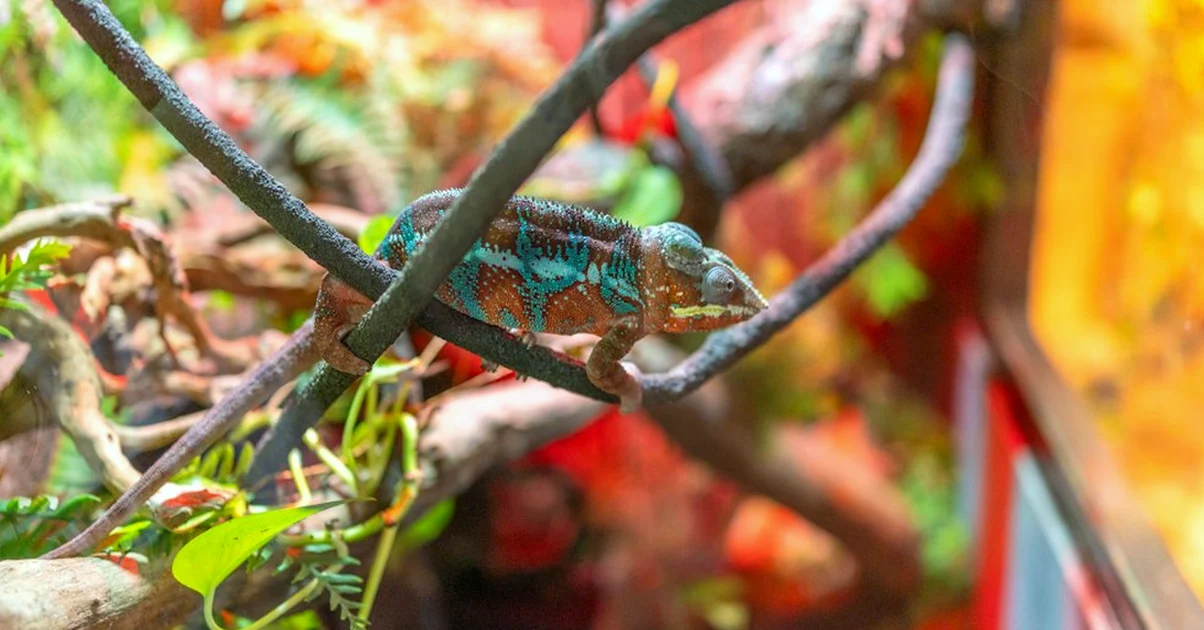
A safe enclosure gives the chameleon branches from shade to basking. It also needs a measured UVB zone and a dry floor after each spray. Decoration comes second. The animal must climb without falling. It must avoid heat when needed. It must drink from leaves without standing water below.
Place UVB and branches as one system
A T5 HO UVB tube is a long fluorescent-style tube. It lights a broad area. Visible brightness does not show UVB output. If a UV Index meter is available, use it. For veiled and panther chameleons, a common basking-branch target is roughly UVI 3 to 6. Adjust this for the lamp, mesh and the manufacturer’s distance chart.
Drain misting water, do not trap it
A misting system must have a water exit. Spray can run through leaves, soil and a drainage layer. It must then reach a tray or outlet. You must be able to empty and clean it. Humidity control needs a wet-and-dry cycle. It does not mean a flooded enclosure.
Record top and bottom temperatures.
Watch where every drop goes.
Leaves and floor should not stay soaked.
Confirm branch distance and UVI.
Plants and branches should form a continuous three-dimensional route. Do not create only one perch below the lamps. Sturdy live plants can provide leaf cover. Suitable choices include pothos, Schefflera arboricola, hibiscus and Ficus benjamina. They must be pesticide-free and securely potted.
Always monitor individual animals and plants. Use clean, firmly fixed branches of different diameters. This helps the feet grip naturally. Put the main horizontal basking branch at the manufacturer’s safe lamp distance.
Veiled and panther chameleon enclosures need dense visual cover. Both also need a shaded retreat and more than one route away from the basking area.
A dry floor matters as much as leafy cover.
What people ask
What size vivarium does a chameleon need?
Adult veiled and panther chameleons usually need at least 60 × 60 × 120 cm. They need 90-120 cm of usable internal climbing height. Measure the space below lights and above the drainage base. Do not measure the external box.
Can you legally own a chameleon in the UK?
Common pet chameleons can usually be kept legally in England. You must meet welfare duties and comply with any CITES paperwork requirements. Check the seller's documents for the species. CITES controls trade in many chameleons. Rules can differ by origin.
Are chameleons hard to care for?
Chameleons are demanding pets. Lighting, airflow, hydration, live food and low handling stress must work together daily. Run and measure a setup for 3-7 days before the animal arrives.
How much does a chameleon setup cost in the UK?
A properly equipped adult setup in the UK commonly costs between £450 and £850 before the animal. This includes the enclosure, UVB, heat, controls and drainage. It also includes plants and basic misting equipment. It does not include emergency reptile veterinary care.
The £450–£850 initial estimate only helps when you plan ongoing costs. Allow separately for replacement UVB tubes at the manufacturer’s stated interval. Plan spare halogen basking lamps and misting-system maintenance. Water treatment may also be needed.
Budget for live plants, feeder insects and gut-load. Include electricity and replacement temperature or humidity probes. Monthly spending varies with the animal’s age, feeder use and room temperature. Food and electricity are recurring costs. They are not one-off purchases.
Keep a small reserve for drainage repairs and an exotics-vet visit. This prevents a cheap-looking enclosure from becoming unaffordable.
Test the system before buying the chameleon
The safest purchase is a complete, tested system. It is not simply the tallest kit on a retailer page. Choose an enclosure that suits your English home’s temperature. Maintain cross-ventilation. Plan where water will leave.
- The essentials: Adult veiled and panther chameleons need tall, usable climbing space rather than impressive external measurements.
- Mesh needs a warm enough room, while glass and PVC need deliberate cross-ventilation.
- Every misting system needs a clean drainage route, not permanently wet substrate.
- Measure temperature, humidity, UVB and dry-out for several days before moving in a chameleon.
Advertisement
Further reading
If you want to learn more about this topic, these sources may interest you:
- Shop Chameleon Terrariums, Cages & Kits - Swell Reptiles — reptiles.swelluk.com
- Buy Chameleon Vivariums Online — reptilecentre.com
- Don't let a UK vivarium dry out your veiled chameleon
- UVB can change how you supplement live and frozen food

The Reptile Vivarium Team
Our guides are based on comparing specialised reptile care sources, keeper community input, and recognised husbandry guidelines — we are not vets or professional breeders, and we say so where it matters.
The information on this site is general in nature. For any concerns about the health or welfare of your reptile or amphibian, always consult an exotics vet.