A tall glass tank can look perfect for dart frogs and still leave them with too little room to forage, retreat or avoid one another.
Dart frog suitability is not defined by litres alone: it depends on usable floor area, species-appropriate height, planted visual barriers, drainage and safe airflow. For most commonly kept dart frogs, temperatures should usually stay around 18–24°C, not rise into the mid-80s°F. Check the true internal dimensions, intended group and mature planting before you buy or move frogs in.
Table of Contents
Advertisement
Check a vivarium before buying frogs
Start with the footprint. Measure the inside width and depth after allowing for a drainage layer, substrate, cork and plants, because those items take away living space.
The five checks that matter
A practical setup needs five things: usable territory, suitable climbing routes, broken sightlines, clean ventilation and a secure lid. Think of it like planning a small flat: its total room size matters less if the furniture blocks every route and there is nowhere private to rest.
Check temperatures with a digital thermometer at frog level, not near the light fitting. Most commonly kept captive-bred dart frogs should remain around 18 to 24°C, with short periods near 26°C treated cautiously; sustained temperatures in the mid-80s °F, around 29°C or more, can become dangerous.
Read the tank as a frog would
Terrestrial Dendrobates spend much of their day moving through leaf litter and low cover. They need several routes between food, shelter and damp areas, rather than one exposed clearing where every frog meets.
Semi-arboreal Ranitomeya can use height well, but only where cork, branches and plants form connected routes. Empty air above one branch is not climbing space.
A secure escape-proof lid is essential because frogs can find gaps around cable holes and sliding doors. Test every opening before a frog arrives, using a torch from inside the closed vivarium to reveal light leaks.
Humidity should support hydrated frogs and living plants without turning the whole enclosure into permanently saturated air. In a dart frog vivarium, use a hygrometer as a trend tool rather than chasing one fixed number: readings may rise after misting and fall as fresh air moves through the enclosure. The practical test is whether there are damp retreats, leaf litter that remains usable rather than waterlogged, and some upper surfaces that dry between sprays.
Constantly wet glass, soaked substrate and stale odours point to excess moisture or weak vivarium ventilation, while crisp leaves, rapidly drying moss and frogs avoiding exposed areas can indicate that the enclosure is drying too quickly. Adjust misting and ventilation gradually, then monitor the result over several days.
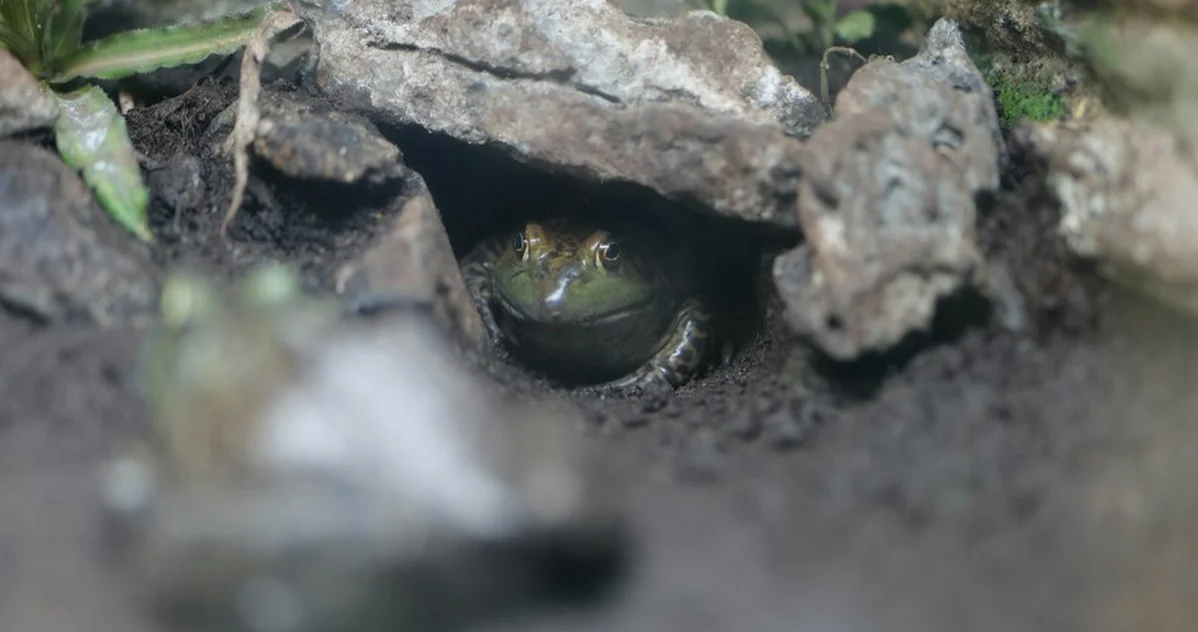
Give terrestrial frogs room to avoid each other
Wide and planted beats tall and bare.
Measure the usable footprint
For a cautious beginner group of two to three small-to-medium terrestrial dart frogs, a useful starting footprint is about 45 to 60 cm wide and 45 cm deep, with more room preferred for larger species, adults or additional animals. This is a starting point, not permission to fill every available centimetre.
Build walls that break sightlines
Visual barriers are plants, cork bark and leaf-litter banks that stop frogs seeing one another constantly. They are not decorative extras; they let a subordinate frog move away without crossing an open stage.
Width × depth × height
Drainage, soil, wood
Cover and separate routes
Space frogs can use
Advertisement
Choose height for climbing species
Height has a purpose only when frogs can travel through it.
A decision table by frog type
| Frog type | Cautious usable space | Useful height | Prudent group | Cover need |
|---|---|---|---|---|
| Terrestrial Dendrobates | 45-60 cm wide, 45 cm deep for 2-3 small frogs | 45 cm or more | Pair or small same-species group | High |
| Larger Phyllobates | 60 cm wide, 45 cm deep or more | 45-60 cm | Small group with extra room | High |
| Climbing Ranitomeya | 45 cm wide, 45 cm deep | 60 cm or more, structured | Pair or carefully planned small group | Very high |
Make vertical routes real
Use cork tubes, angled branches, broad leaves and planted walls so a frog can climb without repeatedly returning to one exposed route. Bromeliad-type plants may hold water, but their cups must stay clean and safe for the species kept.
A front-opening tropical terrarium is easier to plant densely and check at feeding time than a top-opening tank. Filter listings by internal width, depth and vent position, not by litres alone.
- Front doors allow feeding without reaching through the whole planted layout
- Cross-vent panels help prevent permanently wet, stagnant air
- Extra depth leaves room for leaf litter, cork cover and separated feeding zones
Prove the bioactive setup is ready
Plants alone are not a cycle.
Test it before frogs arrive
Run the enclosure for at least 7 to 14 days before introducing frogs, longer if plants are newly rooted or temperatures fluctuate. Log morning and late-afternoon readings with a digital hygrometer and digital thermometer.
Food and safe equipment
Have reliable cultures of flightless Drosophila melanogaster and, for larger frogs, Drosophila hydei before delivery day. Dust feeder flies with suitable calcium and vitamin supplements according to the frog species and product directions.
Before stocking, carry out one final safety check with the enclosure running as it will on an ordinary day. Confirm that the drainage layer does not allow water to flood the substrate, that excess water can be removed if necessary, and that the leaf litter remains above standing water. Use dechlorinated water for misting and water features, establish a modest clean-up crew of springtails and suitable isopods, and check that food cultures are available. Record dart frog temperatures in the morning and late afternoon for several days, inspect every door, vent and cable entry for escape gaps, and make sure cork bark, plants and branches cannot shift or trap a frog.
A stable setup should have reliable ventilation, no sharp edges and no unexplained pooling before animals arrive.
Fix heat, stale air and crowding first
Do not add frogs to solve an unfinished setup.
Signs the tank needs changing
Persistent condensation all day, sour-smelling substrate and mould spreading beyond a small patch suggest inadequate ventilation or excess moisture. Add or improve cross-ventilation, reduce misting, and make sure vents are not blocked by background foam or plants.
Reduce social pressure safely
Overcrowding often appears as one frog gaining every feeding area while another stays hidden or loses condition. Separate frogs promptly if bullying, repeated chasing, injury or poor feeding occurs.
If an existing enclosure is unsuitable, correct the limiting factor rather than trying to compensate with extra decoration. A Dendrobates enclosure that is too narrow cannot become a good terrestrial dart frog setup simply by adding more height: move the frogs to a wider vivarium footprint, or keep a smaller, appropriate group until an upgrade is ready. For a Ranitomeya enclosure, add securely anchored cork, branches and dense planting to create several connected routes, but upgrade if the floor plan still leaves only one feeding or resting zone.
Remove bulky hardscape that blocks movement, create visual barriers and broken sightlines with plants and cork, and improve cross-ventilation before reducing misting. If the enclosure overheats, relocate it away from sun and heat sources rather than relying on stronger spraying, which can worsen stagnant conditions.
Advertisement
Your questions answered
What do dart frogs need in their enclosure?
Dart frogs need a secure planted enclosure with usable space, clean airflow, dechlorinated water, leaf litter, hides and stable temperatures around 18 to 24°C. They also need reliable fruit flies, species-suitable supplements and minimal handling.
What is the best enclosure for dart frogs?
The best enclosure is a front-opening, escape-proof vivarium sized for the species’ usable floor area and climbing behaviour. For terrestrial frogs, extra width and depth usually matter more than extra empty height.
How should dart frogs be kept in the UK?
In the UK, keep captive-bred dart frogs indoors away from direct sun, radiators and cold draughts. Monitor the enclosure twice daily during heatwaves, because small glass vivaria can exceed 26°C quickly.
How big should a dart frog enclosure be?
A cautious starting footprint for two to three small terrestrial frogs is roughly 45 to 60 cm wide by 45 cm deep. Larger species, adults and groups need more room, while climbing species also need about 60 cm of connected vertical structure.
Can I keep different dart frog species together?
Beginners should keep one species per enclosure, even in a large vivarium. Mixing species can create food competition, disease risk and hidden territorial stress that size alone cannot prevent.
How long should a bioactive vivarium run first?
Run a newly built bioactive vivarium for at least 7 to 14 days before adding frogs. Wait longer if drainage floods, plants wilt, temperatures vary or feeder flies are not ready.
Choose space before decoration
A well-planned vivarium gives frogs choices.
- Measure usable floor area after drainage, substrate and hardscape, not the advertised litre capacity.
- Match width and depth to terrestrial species, while giving climbing species connected vertical routes.
- Run and monitor a planted system for 7 to 14 days before frogs arrive.
- Fix heat, stagnant air and social crowding before introducing or adding animals.
For further planning, compare this assessment with a species-specific care sheet and a guide to bioactive vivarium cycling before choosing frogs or plants.
Further reading
If you want to learn more about this topic, these sources may interest you:
- How To Build A Bioactive Vivarium For Dart Frogs ... — frogfather.co.uk
- Dart Frogs Care Guide — elyexotics.co.uk

The Reptile Vivarium Team
Our guides are based on comparing specialised reptile care sources, keeper community input, and recognised husbandry guidelines — we are not vets or professional breeders, and we say so where it matters.
The information on this site is general in nature. For any concerns about the health or welfare of your reptile or amphibian, always consult an exotics vet.